開
kāi HSK1

open

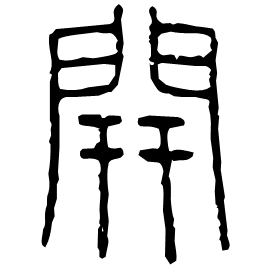
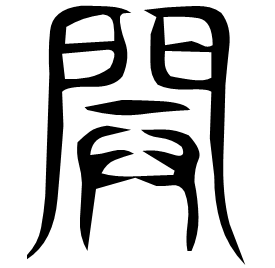
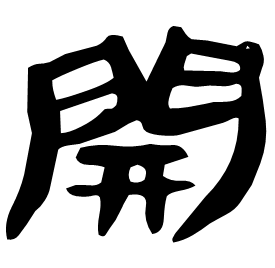
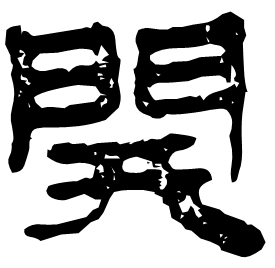
Pictograph of two hands (廾) opening the bolt (一) on a door (門).

Components

門
門 Iconic component
mén, men door
◎
◎ Iconic component
characterless component

Depicts a bolt on a door.

廾
廾 Iconic component
gǒng two hands

Character Evolution

Seal form
Seal Qin 221-206 BC
Seal form
Seal Shuowen ~100 AD
Seal form
Seal Shuowen ~100 AD
Clerical form
Clerical Qin 221-206 BC
Clerical form
Clerical Western Han 202 BC-9 AD
Clerical form
Clerical Eastern Han 25-220 AD
Regular Modern

Historical Pronunciations

Middle ChineseOld ChineseGloss
Baxter-SagartkhojNə-[k]ʰˤəj to open (v.i.)
khoj[k]ʰˤəj to open (v.t.)

說文解字

《說文》:“開,張也。从門,从幵。,古文開。”

Sources

Character origin
季旭昇《說文新證》p.836
Readings & variants
Unicode
Historical pronunciations
Baxter-Sagart
Historical images
Academia Sinica

开 kāi open Simplified

Simplified form of 開. Pictograph of two hands (廾) opening the bolt (一) on a door (門). The traditional component 門 was removed for simplification.

Components

開
門 Deleted component
mén, men door

The traditional component 門 was removed for simplification.

◎
◎ Iconic component
characterless component

Depicts a bolt on a door.

廾
廾 Iconic component
gǒng two hands

Component uses

Sound (0 of 5 verified)

Meaning (0 of 2 verified)

Sources

Character origin
季旭昇《說文新證》p.836
Readings & variants
Unicode

𫔭 kāi, qiān open Simplified

Variant of 開. Pictograph of two hands (廾) opening the bolt (一) on a door (门).

Components

门
门 Iconic component
mén, men door
◎
◎ Iconic component
characterless component

Depicts a bolt on a door.

廾
廾 Iconic component
gǒng two hands

Sources

Character origin
季旭昇《說文新證》p.836
Readings & variants
Unicode